For tattooed parents
How to explain your tattoos to your kids
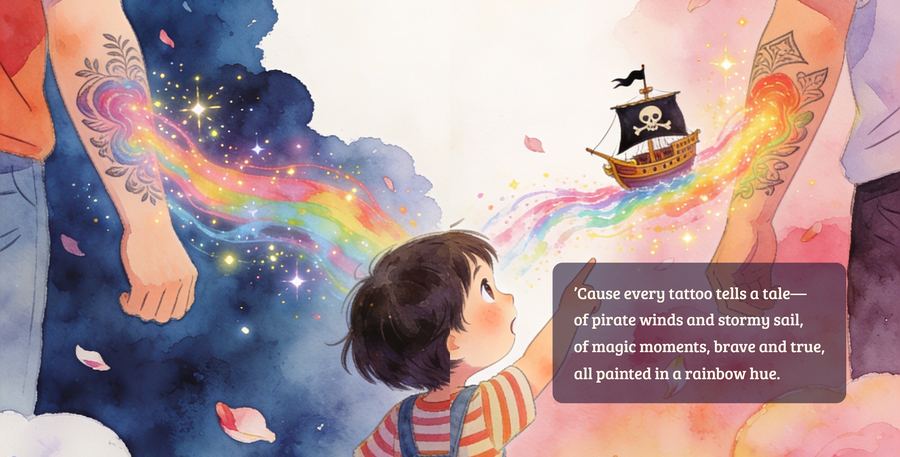
Sooner or later a small finger lands on your arm: “What’s that?” If you’ve wondered how to explain tattoos to a child, here’s the good news: it’s one of the easiest conversations you’ll ever have, because kids aren’t judging. They’re curious. Here’s how to answer at every age, plus the questions that come up most. (We also wrote a picture book about parents with tattoos for exactly this moment.)
Start with the story, not the ink
Kids don’t need to know about needles, shops or prices first. They want to know what the picture is and why it’s there. Every tattoo has a reason behind it: a place, a person, a pet, a memory, a joke. That reason is the part a child can understand, and it’s the part that turns “What’s that?” into a conversation about you.
“This one is a compass. I got it to remember a trip I took before you were born. Want to hear about it?”
If a tattoo doesn’t have a deep meaning, say so. “I just thought it looked cool” is a perfectly good answer, and an honest one.
What to say, by age
Toddlers (about 2–3)
Keep it short and concrete. At this age a tattoo is just a picture that lives on your skin.
“It’s a picture on my arm. It stays there. That’s a bird. Can you find its wing?”
Pointing games work well: find the flower, count the stars, trace the line with a finger.
Preschool and early school (about 4–8)
This is the “why?” age, and the best age for stories. Pick one tattoo at a time and tell its tale. Kids this age will ask the same question twice, then tell the story back to you a week later, sometimes to a stranger at the store.
- Name the tattoo and the reason behind it.
- Answer “did it hurt?” honestly and simply (more on that below).
- Explain that tattoos are for grown-ups, the same way driving is.
Older kids (about 9 and up)
Older kids can handle the bigger ideas: that tattoos are permanent, that people choose them carefully (or sometimes don’t), and that different families feel differently about them. This is a good age to talk about making choices about your own body, and about respecting people whose choices differ from yours.
The questions kids ask most
“Did it hurt?”
“A little, kind of like a scratch that lasts a while. I decided the picture was worth it.”
Honest and calm is the goal. No need for drama in either direction.
“Will it wash off?”
“No, it’s under the top layer of skin, so it stays for good. That’s why grown-ups think hard before they get one.”
“Can I get one?”
“Real ones are for grown-ups. But we can make you one right now.”
Temporary tattoos, washable markers and a drawing on paper all scratch the itch. Letting a child design a tattoo for you, on paper, is a fun one too.
“Can kids get tattoos?”
“Real tattoos are just for grown-ups. You have to be 18, the same way you have to be big to drive a car.”
For you, the parent: in the US the age rule is set state by state. Most states make 18 the minimum, and some let older teens get one with a parent’s written consent. Little kids don’t need those details, just the simple version above. Then give them the fun alternative: a temporary tattoo, a drawing with skin-safe markers, or a free design-your-own-tattoo coloring page.
“Is that tattoo about me?”
If you have a child’s name, birth date, footprints or handprint inked on you, that’s the easiest tattoo story in the world to tell, and kids love being the star of it.
“This one is your name. I got it the year you were born, so I could carry you with me everywhere.”
Let them trace their own name or press their hand against the print. If a brother or sister asks why there isn’t one for them yet, be honest, or let them help design it.
“What does it mean?”
Tell the true version, sized for their age. If the real story is sad (a loss, a hard year), a gentle version is fine: “It reminds me of someone I loved very much.” You can tell them more when they’re older.
“Why is that kid staring at your arm?”
Kids notice when other people notice. Give your child something easy to say, so stares feel like an invitation instead of a problem:
“My mom’s tattoos tell stories. Want to hear one?”
It teaches them that people look different, that curiosity is fine, and that their family is something to be proud of.
When your teen asks for a tattoo
Sooner or later the question changes from “Can I touch it?” to “Can I get one?”, and this time they mean it. Start with curiosity, not a quick no. Ask what they want and what it means to them. You’ll learn a lot, and they’ll feel heard.
Then talk about waiting. A good test: keep the design on paper, or as their phone wallpaper, for six months. If they still love it, that tells you something. Talk about placement too: somewhere they can cover for a job interview, and a size they’ll still like at thirty.
Be plain about the rule. In most states it’s 18, and in some a parent can give written consent for an older teen. Whatever your answer is, give your reasons. If you got yours young, tell them what you’d do the same and what you’d do differently.
One firm line worth drawing: no at-home kits or “stick and poke” tattoos from friends. A licensed shop is clean and careful, and it won’t tattoo a minor without the right paperwork. That’s exactly the point.
A few things that help
- Tell one story at a time. A tattoo a night at bedtime goes a long way.
- Let them touch and trace. It makes the pictures feel friendly, not strange.
- Draw together. Print a free coloring page of Mommy’s tattoos and let them add their own, or grab our free pack of six coloring pages with a design-your-own-tattoo page.
- Be honest about the ones you’d choose differently now. “I was young and I liked it then” is a useful lesson in itself.
- Read it together. A picture book gives you both the words, and the pictures to point at. Here’s our list of children’s books about tattoos.
Quick answers
How do I explain tattoos to a toddler?
Keep it short and concrete: “It’s a picture on my arm, and it stays there.” Then turn it into a game: find the bird, count the stars, trace the line with a finger. Toddlers don’t need the why yet. They just need it to feel friendly and familiar.
What do I say when my child asks if it hurt?
Tell the truth, calmly: “A little, like a scratch that lasts a while. I decided the picture was worth it.” Kids take their cue from your tone, so skip the drama in either direction. Answer follow-up questions simply, and stop when they’re satisfied.
Can kids get tattoos?
No. Real tattoos are for adults. In the US, most states set the minimum age at 18, and some let older teens get one with a parent’s written consent. For kids, temporary tattoos, skin-safe markers and a design-your-own-tattoo coloring page are the fun stand-ins.
Is there a book that explains tattoos to kids?
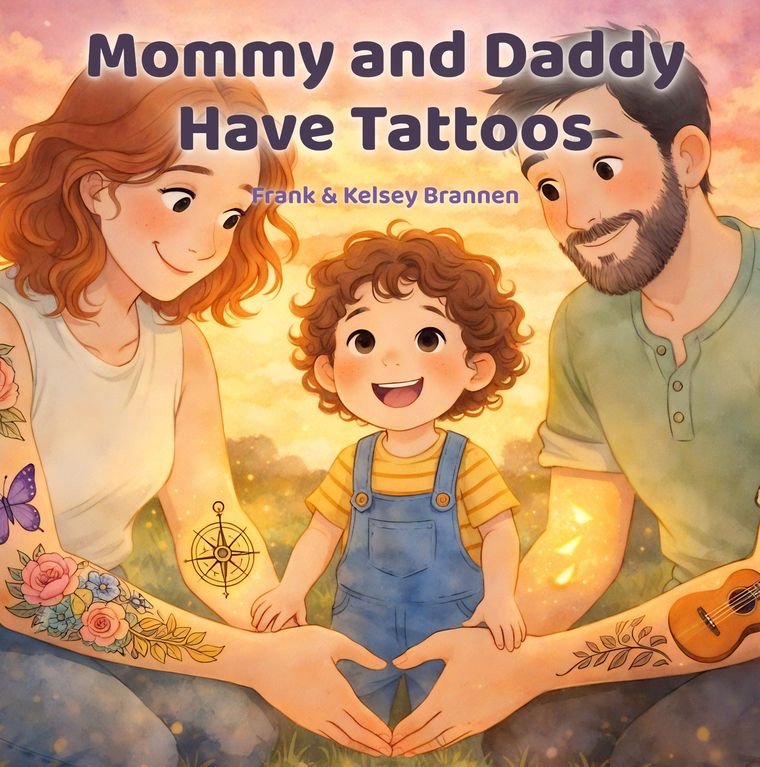
Yes. Mommy and Daddy Have Tattoos is a rhyming read-aloud picture book for ages 3–8 about a little one discovering the stories behind Mom and Dad’s tattoos. A key in the back helps you tell your own stories, and two coloring pages let kids design their own.
What if my child wants a tattoo right now?
Make them one today: draw it on with a skin-safe marker, put on a temporary tattoo, or let them design one on paper for you. It honors the wish without the permanence, and it keeps the conversation going until they’re old enough to choose for real.
A book for exactly this conversation
Mommy and Daddy Have Tattoos is a read-aloud picture book for ages 3–8. A curious little one learns that every swirl and splash on Mom and Dad’s skin holds a tale. A key in the back helps you tell the real stories behind your own ink, and two coloring pages let kids design their own.
Grown kid came home with a tattoo of their own? That’s a different conversation, and there’s a book for it too: Our Kids Have Tattoos, a picture book for parents whose grown kids came home with ink.